
Social Media Calendar Template
Draft each social post with its platform, date and time, and this planner checks the caption against that platform’s character and hashtag limits as you type. Build up a queue for the month, see it laid out by week, and export it as an .ics file that opens in Google Calendar, Outlook or Apple Calendar — so posting reminders appear on your phone — or as a CSV for your spreadsheet.
- Free to use
- No sign-up
- Runs in your browser
Social media post planner
Social Media Calendar Kit
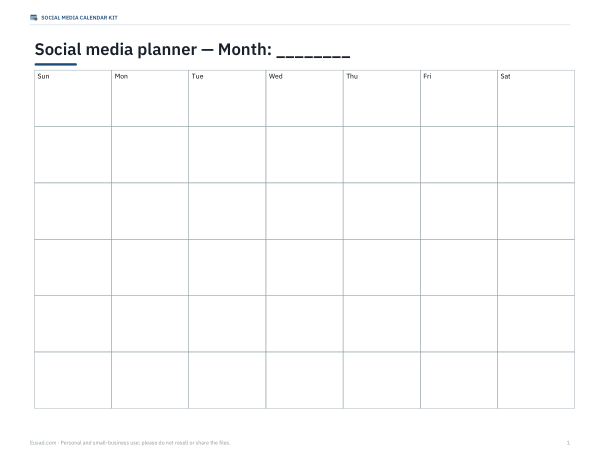
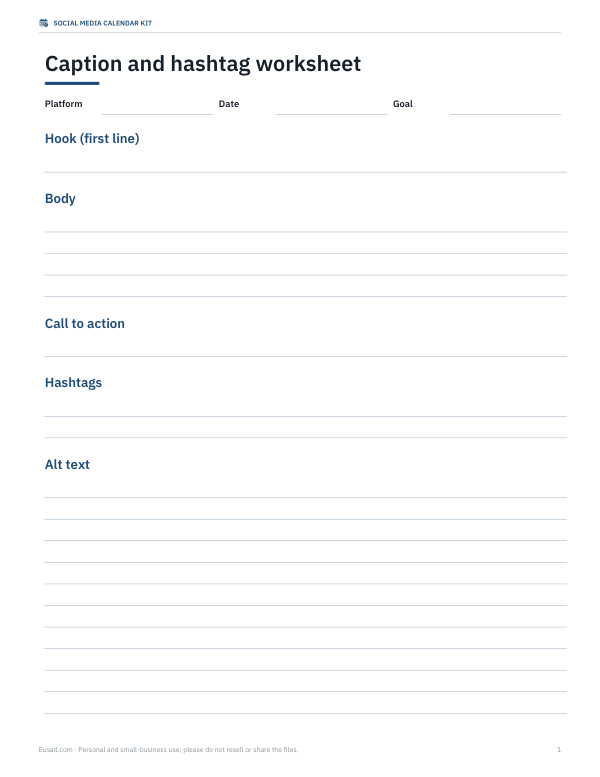
Excel social media calendar with platform tabs and character-count formulas, a printable monthly social planner, a caption and hashtag worksheet, a platform limits cheat sheet and a monthly analytics review sheet.
- Social calendar (XLSX)
- Monthly planner (PDF)
- Caption worksheet (DOCX/PDF)
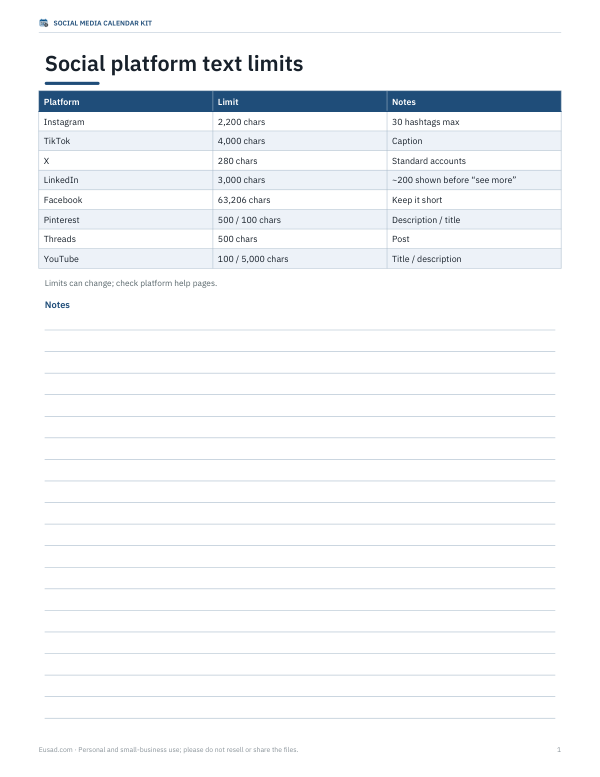
- Limits cheat sheet (PDF)
- Analytics review (XLSX)
Formats: XLSX, PDF, DOCX. Instant download after payment (link valid 72 hours, up to 5 downloads). AI-assisted: the templates were drafted with AI help and reviewed and laid out before publishing.
$5.00 USD, one-time 5 files · about $1.00 each
- Instant download
- 7-day refund
- Secure checkout by Stripe
7-day money-back guarantee. Full refund within 7 days of purchase, even after you download.
Free sample: Caption Worksheet (PDF, 52 KB)
Full refund within 7 days — see the refund policy and license.
Free printables
Single sheets you can print right now, no sign-up. The full pack adds every sheet in one download plus the editable files.
 Printable Social Media Analytics Review
Platform limits at a glance
| Platform | Text limit | Notes |
|---|---|---|
| 2,200-character caption | Up to 30 hashtags; only the first lines show before “more” | |
| TikTok | 4,000-character caption | Short captions usually perform best with video |
| X (Twitter) | 280 characters for standard accounts | Links count as a fixed length; longer posts need a paid plan |
| 3,000-character post | About the first 200 characters show before “see more” | |
| 63,206-character post | Short posts are easier to read in the feed | |
| 500-character description, 100-character title | Keyword-rich descriptions help search | |
| Threads | 500-character post | Conversational, text-first |
| YouTube | 100-character title, 5,000-character description | Front-load keywords in titles |
Platforms change their limits from time to time; check each platform’s help pages if a post is rejected.
Why plan social posts on a calendar
A social media calendar keeps posting consistent, helps you balance topics and formats, and prevents gaps during busy weeks. Seeing posts by date makes it easy to line up campaigns with launches, holidays and events, and to spread different platforms across the week. Drafting captions in advance gives time for proofreading, approvals and better visuals.
How the planner works
- Choose a platform, date and time, and a post type (reel, carousel, story, thread, short, pin).
- Write the caption. The checker counts characters (emoji count as one), hashtags and mentions against that platform’s limit.
- Click “Add to calendar” to put the post in your list — it is saved in this browser.
- Repeat for the month.
- Export as .ics to add posting reminders to Google Calendar, Outlook or Apple Calendar, or as CSV for a spreadsheet or scheduling tool.
Each calendar event includes the caption in its description and a reminder 15 minutes before, so you can copy and post from your phone.
Choosing posting times
The best time to post depends on your own audience — their time zones, work patterns and habits — more than on general advice. Check the insights or analytics in each platform to see when your followers are active, test a few time slots for a month, and compare reach and engagement. Schedule in your audience’s time zone, not necessarily your own.
Writing captions that work
- Lead with the hook — the first line shows in the feed.
- Write for the platform: short and punchy on X and Threads, more context on LinkedIn, searchable keywords on Pinterest and YouTube.
- Use a clear call to action: comment, save, click, share.
- Keep hashtags relevant; a few targeted tags usually beat dozens of generic ones.
- Add alt text to images where the platform allows.
- Proofread names, links and dates.
Worked example
A small clothing boutique plans the first week of November: an Instagram carousel on Tuesday at 12:30 (“5 ways to style one scarf”, 97 characters, 3 hashtags), a TikTok try-on video on Wednesday evening, a LinkedIn post about the shop’s new local supplier on Thursday morning, and a Pinterest pin for the scarf guide on Friday. The checker flags that an early X draft of the scarf post is 312 characters — over the 280 limit — so they shorten it. They export the week as an .ics file and get reminders on their phones.
Content mix for social
Many brands aim for a mix of educational, entertaining, community and promotional posts, so followers get value and not just sales messages. A simple approach is to decide your main content types — tips, behind the scenes, user-generated content, product posts, announcements — and check that each week includes a few of each. Reusing a successful format (for example a weekly “tip Tuesday”) makes planning faster and helps followers know what to expect.
Accessibility checklist
- Write alt text for images on platforms that support it.
- Add captions to videos — many people watch without sound.
- Use CamelCase for multi-word hashtags (#AutumnStyle) so screen readers read them correctly.
- Avoid putting important text only inside images.
- Keep emoji use moderate; screen readers read each one aloud.
Social media calendar vs content calendar
A content calendar covers everything you publish — blog articles, newsletters, videos and social posts. A social media calendar focuses on posts: the exact caption, platform, time and format. Many teams keep a content calendar for planning themes and a social calendar for day-to-day publishing.
Privacy
Posts are stored only in this browser’s local storage and in the files you export. Nothing is sent to any server or social platform.
Frequently asked questions
What is the Instagram caption limit?
2,200 characters, with up to 30 hashtags.
How many characters can I use on X?
280 for standard accounts.
Can I import my plan into Google Calendar?
Yes, export the .ics file and import it.
Does the planner post for me?
No, it creates reminders; post manually or use a scheduling tool.
Where are my posts saved?
In your browser’s local storage on this device only.
Do emoji count as characters?
Yes; the checker counts each emoji as one character, though some platforms count certain emoji as two.
How many hashtags should I use?
Only relevant ones: a handful of targeted hashtags usually works better than the maximum.
Can I plan stories and reels too?
Yes, set the post type to story, reel or short and add a note in the caption field.
Will my list be there next time?
Yes, on the same browser and device, unless you clear site data.